
My First Analysis
The Shallow Dive #1: A.O. Smith ($AOS)

As well as providing you with what will hopefully be the greatest analysis on A.O. Smith in the history of finance, this article will also serve to show you the investment and decision process I’ve come up with. If you read my second article, “How I’ll be Investing”, you’ll know that the main goal of my process is not profits, but instead to keep me from doing something stupid - no small feat.
My process looks at Predictability, Economic Strength, Moat and Management. Then it turns away from the business and instead tests the investor - me. I take my investors hat off, replace it with my owner’s hat and check to see if the thesis holds up under that switch in mindset.
When trying to succeed at something, it’s very important to not fail. For that reason, as I’ve said before, A.O. Smith will be presumed guily until proven innocent in the Court of Liam and will have to fight for its right to live. It’s very important that we present ourselves with the counter-arguement to our best ideas. Ask yourself: what would break this thesis?
Anyway, enough jibber jabber - here’s my first ever analysis, a Shallow Dive on A.O. Smith:
Round 1 - Predictability
This is my favourite round because it takes almost zero work and I really like doing nothing.
Before I’ve opened a single annual report, before I’ve checked in on management and before I ever let myself get too attached like the needy little man I am, I head online, search up the company and have a look at the earnings charts, specifically Net Income and Free Cash Flow. If these charts are ugly and not going at least directionally upwards then I have essentially zero chance of being able to forecast its future earnings or predict its future margins. Remember: even highly predictable businesses are hard to forecast, nevermind the bipolar ones.
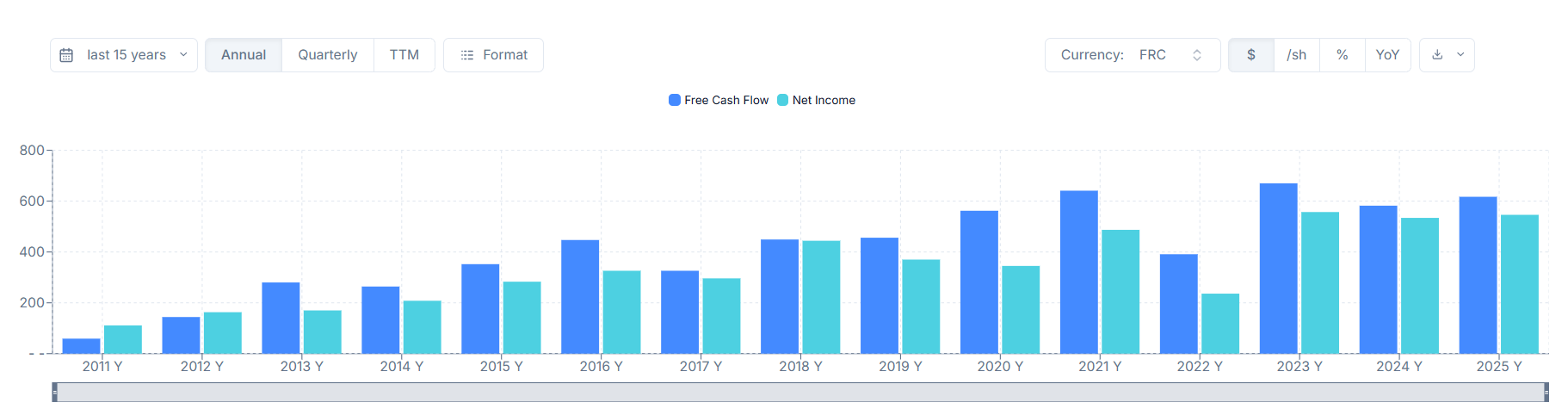
It’s definitely not perfect. But it ain’t half bad either. Something is clearly going right here, something is clearly working. Now, what that “thing” is, we don’t know yet, but for now, this is enough. It’s that easy, that simple. A.O. Smith passes Round 1.
I told you I like doing nothing.
Round 2 - Economics
Okay, now we have to do some actual work unfortunately.
In this round, we check the strength of the financials. It’s a good thing we look at this early because it means that if the castle is built on shaky foundations, we can exit quickly without losing much time.
I look at four things: Growth, Profitability, Financial Strength and Capital Efficiency. I get the financials of the last ten years and break down my desired metrics from that. Here’s how it looks:
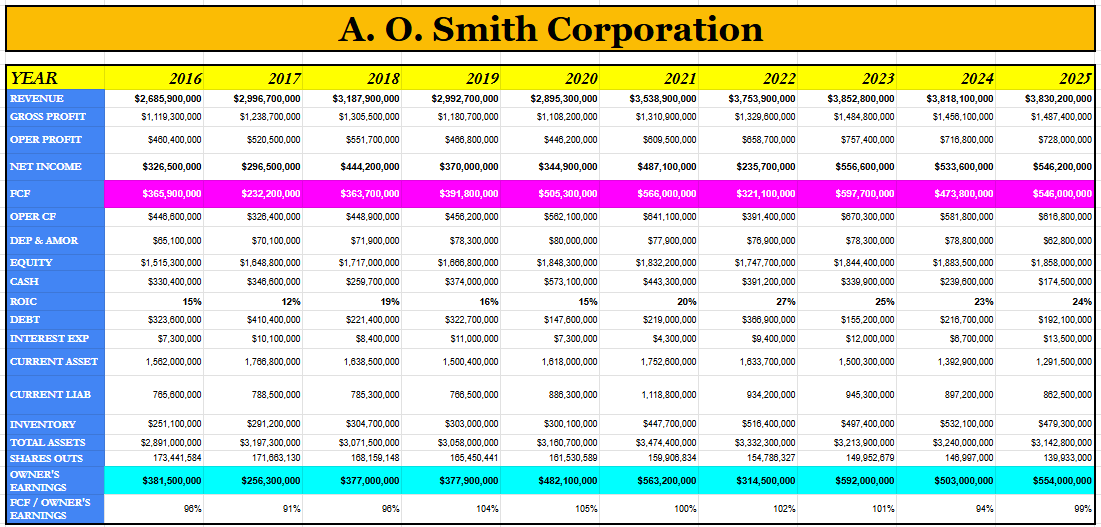
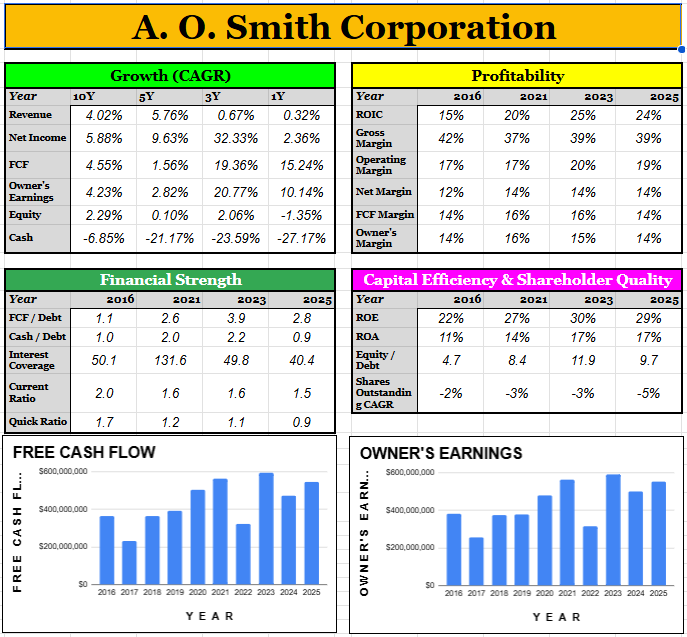
Shut up, I can’t afford Excel yet.
I like this view because we can see a few important things really quickly:
Sales has slowed way down
Earnings have completely outpaced Sales
Margins have been incredibly consistent
Even though cash is decreasing, Debt is a non-issue
Management love buybacks
Getting this information so quickly is incredibly helpful as the decision to pass or fail the business based on Round 2 is made very simple. While we certainly don’t have all the facts yet, we do know two things:
A.O. Smith is relatively predictable
A.O. Smith is fairly strong financially
That’s some fairly impactful knowledge to possess as an investor.
I like to give a little Round 2 score to the business just so I can rank and prioritise later. I usually go with Gold, Silver, Bronze or Fail. And no, I have not yet come up with a better system, but at least this keeps it simple.
This is a pure judgement call for the investor and in this particular case, I’m inclined to go Gold. If you disagree with my rating and now hate me and everything I stand for and you wish a plague upon my family, don’t worry too much, the rating means very little in the grand scheme of the analysis.
Anyway, thats a pass for Round 2. Onwards.
Round 3 - Moat
I realise I haven’t actually gone into what AOS does yet and that’s deliberate. As far as I’m concerned, the first two rounds have absolutely nothing to do with what the business actually does, that can be determined later. And, well, here we are. This is later.
Here is what A.O. Smith does (get ready to fall asleep):
A. O. Smith Corporation manufactures and markets residential and commercial gas, electric, tankless, heat pumps and solar water heaters, boilers, storage tanks, expansion tanks, swimming pool and spa heaters and water treatment products; including point-of-entry softeners, whole-home filtration systems, well water solutions, point-of-use reverse osmosis and carbon filters, and commercial filtration worldwide.
It’s mundane and boring and hard to read and I absolutely love it.
SpaceX wants to take us all to Mars and while that’s fascinating, it doesn’t necessarily equal investor gains. But water heaters? Heat pumps? Boilers? I can almost smell the cash.
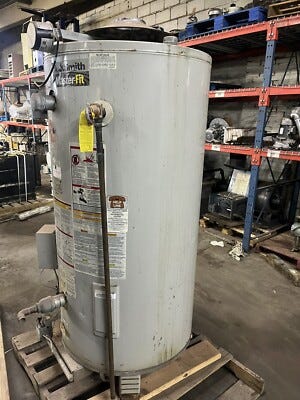
Now, this industry isn’t without rivals: Rheem, Bradford White, Rinnai, Pentair… But for an industry with such genuine competition, how is AOS managing, achieving and sustaining such high Returns on Invested Capital? Competitive markets are supposed to erode excess profits. If a company consistently earns exceptional returns over many years, something must be protecting those economics. There must be a Moat. Or, in this case, Moat(s).
Brand
Water heaters are not exactly “sexy”, or at least I don’t think so. But they are products that homeowners and commercial customers expect to last for well over a decade. This is an industry where reliability REALLY matters. A failing water heater isn't just inconvenient—it’s the worst day of your life. That makes trust a very, very valuable asset.
We see this in AOS’ annual reports where management frequently emphasise the importance of dealing only in premium products, giving them decent pricing power as opposed to competing for market share through discounting.
Distribution
Homeowner’s don’t really choose a new water heater by comparing a bunch of brands online, instead the purchasing decision is influenced by the contractor, plumber or distributor replacing a failed unit. This is where AOS has created an advantage that doesn’t appear on their balance sheet: installer relationships.
The relationship AOS has developed with installers over decades creates significant barriers to entry for any new entrants to the market. Why would a plumber bother replacing a failed water heater in someone’s home with an unknown and unproven product from a Peter Thiel-backed startup called TheWaterHeaterGuys.com when they can just use ole reliable? I have the answer: they wouldn’t.
The Business of Replacement
Regardless of economic cycles, politics or who wins Love Island, water heaters, at some point, will break down and fail.
While new housing activity obviously affects demand to a certain degree, a large portion of the sales come from replacing units already in service. This gives earnings a really nice resilience not often seen in industrial businesses, as new customers don’t necessarily need to be created in order for AOS to continue making money.
Now that’s a soothing thought for this scared, conservative little investor.
Scale & Consistency
One theme appears consistently throughout the last five annual reports: management continues to invest through the cycle.
Whether expanding manufacturing capacity, developing heat pump technology or broadening its water treatment portfolio through acquisitions, the company has focused on strengthening its existing franchise rather than reinventing itself and they’ve done this consistently through the most uncertain of times under a certain orange leader.
This helps explain why they’ve maintained attractive returns despite changing regulations and evolving customer preferences.
The companies scale is truly huge, operating across North America, Europe and Asia. They conduct this level of operations while simultanously investing in automation, R&D and production capacity. These investments allow the company to spread their fixed costs over a very large sales base, improve manufacturing efficiency and develop new technologies. This is something a new competitor would likely find daunting, if not insurmountable.
Pricing Power
The last five years have seen manufacturers face significant inflation on raw materials, freight and even labour costs. Most businesses would see their margins compressed under circumstances like these - BUT NOT A.O. SMITH, BUDDY!!!!!!
Gross margins moved modestly at best but operating margins remained incredibly resilient, suggesting the company was able to pass on higher costs without damaging their demand. Oh we like that.
When combined with the consistently high returns on capital we saw in Round 2, the evidence suggests that the company's competitive position remains very much intact.
Verdict
All in all, its not about any single competitive advantage. It’s about how each advantage reinforce each other.
A trusted brand strengthens distributor relationships. Distribution supports pricing power. Scale funds engineering and innovation. Better products reinforce the brand.
No individual element is impossible to replicate. That’s for certain. However, replicating all of them simultaneously would be extremely difficult regardless of resources. It’s fairly obvious now why A.O. Smith has consistently earned returns on capital well above the average industrial manufacturer.
I’m gonna go ahead and give AOS another big lovely GOLD for Round 3.
If you haven’t already, and you like what you see, subscribe!
Round 4 - Management
“Sometimes management deserves all the credit.”
~ My manager the other day
And sometimes they're just very lucky that they operate a fantastic business. My job here in Round 4 is to separate the two.
I’ll say straight up that I don’t think A.O. Smith’s management is absolutely perfect. I do, however, think they’re pretty damn good. The best compliment I could give them is that they genuinely seem to think less like short-term operators and more like long-term owners. This is huge for me. As a long-term guy, my entire mindset around investing centres around ownership.
Allow me to show you why I like them.
Communication
Annual reports are really really easy to write when things are going great.
It’s in the tough times however, that you really get to see what the leaders of the business are made of.

Between 2021 and 2025, A.O. Smith faced supply chain disruption, inflation, a severe downturn in the Chinese property market and weakening residential demand. These guys could not catch a break.
Rather than dismissing these issues or blaming temporary factors, management discussed them openly in the reports, explained their impact on the business and outlined how they intended to respond.
This may sound small, but credibility, like a great business, compounds over time. As an investor, as an owner, I should be able to trust management most when conditions are difficult—not just when results are good.
Capital Allocation
Great capital allocators understand that every dollar retained by the business should earn an attractive return. Over the past five years, I think A.O. Smith has largely passed that test.
Rather than pursuing large, transformational acquisitions like buying Uber or something, management focused on smaller bolt-on deals that strengthened their existing product categories, particularly in water treatment.
This fits nicely into Buffett’s idea of the Circle of Competence. He doesn’t just think that investor’s ought to stick to what they understand, he thinks businesses should too. Imagine, for instance, if Microsoft bought Cheesecake Factory. It just looks weird.
At the same time, they’ve continued to invest in manufacturing, R&D, increased the dividend and repurchased shares without weakening the balance sheet.
This is exactly the type of capital allocation I love to see from a mature industrial business. The goal wasn't to chase growth for growth's sake—it was to strengthen the company's competitive position while returning excess cash to shareholders. Yum.
Execution
Everyone has great ideas and amazing strategies. Everyone. Even that Uncle you only see at Christmas who loves Piers Morgan and thinks Ronaldo is better than Messi.
But, in the end, the only thing that matters is execution.

Despite operating through one of the most challenging periods for global manufacturers in recent history, A.O. Smith maintained high margins, generated healthy free cash flow and preserved excellent returns on capital.
The company's response to China's slowdown was particularly impressive. Rather than aggressively pursuing growth, management restructured operations, reduced costs and protected profitability while continuing to invest in markets with stronger long-term prospects, such as India.
To me, this is a great sign that management is not reactive, but disciplined.
Long-Term Mindset
One characteristic appeared consistently across every report:
Management rarely spoke about the next quarter.
Instead, they repeatedly discussed manufacturing investment, product innovation, heat pump technology, water treatment, operational efficiency and expanding the business thoughtfully.
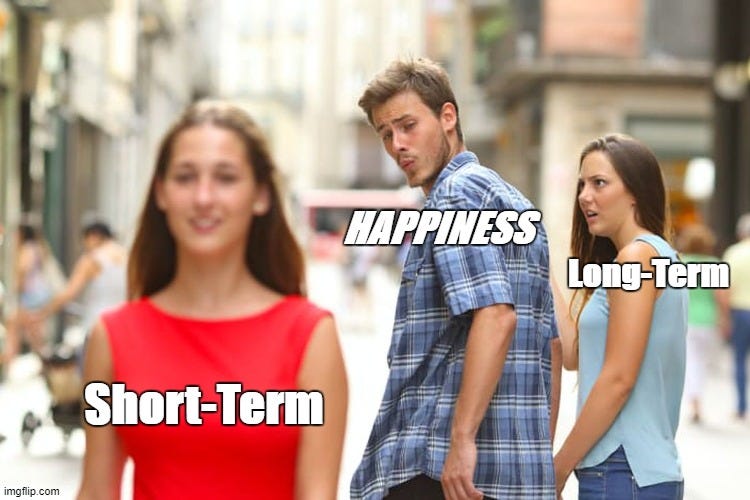
Importantly, those weren’t just words. Capital expenditure, acquisitions and product development all aligned with that long-term strategy. This is why I think it’s important to read the last five annual reports: one annual report will tell you what management is saying, five will tell you what they’re doing.
Where I Worried a Little
For A.O. Smith, the biggest question still remains China.

While management didn’t cause China’s housing downturn (or at least I hope they didn’t…), future capital allocation decisions in the region will matter.
I’ll continue watching to ensure they remain disciplined, avoid throwing good money after bad and continue prioritising shareholder returns over chasing market share. But, to be fair to them, these are things they’ve already been doing for a while now, so my faith in them is high.
Verdict
I came away really liking A.O. Smith’s management.

Management communicates candidly, allocates rationally, invests consistently and has demonstrated a willingness to make difficult decisions when conditions deteriorate.
The quality of A.O. Smith's business is impressive. But just as impressive is that management never appears willing to sacrifice that quality in pursuit of faster growth.
Could they make mistakes in the future? I guarantee you they will.
But based on the evidence available today, I do genuinely believe management has earned the trust of long-term shareholders and that is no easy feat.
You know what’s coming…
GOLD.
Owner’s Test
Okay so we’ve now basically decided that A.O. Smith is a terrific business and one that is worthy of investment. That much is clear.
But hold your horses. We aren’t done yet.
It’s all well and good to come to a conclusion on the business, but what happens when we flip the spotlight? Onto me.
I call this the Owner’s Test because I’ve come up with ten questions that I have to answer thoroughly before ever purchasing the shares of any business. The overall question we’re trying to answer in this section is:
Would I genuinely want to own this business?
Notice that a business that failed Round 1-4 wouldn’t even get to have these questions asked about it, therefore keeping me from doing something really stupid, saving me from myself.
1. If markets closed for 15 years, would I happily own this business?
Yes.
If stock prices disappeared tomorrow, I’d still own a business that manufactures essential products, enjoys recurring replacement demand, consistently generates strong cash flow, earns excellent returns on capital and is run by disciplined management.
I wouldn’t spend the next fifteen years worrying whether the business would survive, (everyone needs hot water) I’d simply expect it to continue quietly compounding.
2. Would I buy the entire company if I could?
Yes.
This is exactly the type of business private owners love to own.
It’s understandable, financially strong, conservatively financed and has a long history of creating shareholder value.
The fact that it isn’t a high-growth technology company doesn’t bother me. I’m kind of boring like that. I’d rather own a predictable compounder than a fashionable business whose future is impossible to forecast.
3. What is the strongest bear case?
The strongest bear case I can come up with is that A.O. Smith has become a mature business with a shorter growth runway than investors may hope for.
North America is already well penetrated.
China is no longer the growth engine it once was. In fact, it’s kind of the opposite.
Future growth increasingly depends on premium products, water treatment and India.
If revenue growth remains subdued, future shareholder returns may rely more on operational excellence than meaningful top-line growth.
The bear case is definitely real.
4. What could permanently damage the moat?
Several things.
The most significant would be a loss of pricing power.
If water heaters gradually became commoditised and customers stopped valuing A.O. Smith’s brand, engineering quality and distribution network, margins and returns on capital would almost definitely fall.
I also worry about:
failure to lead in heat pump technology over time,
losing contractor and distributor relationships,
poor capital allocation,
large acquisitions outside the company’s core competencies.
Those are genuine long-term risks.
5. If the stock doubled tomorrow, would I still want to own the business?
Yes.
The business wouldn’t become any less attractive simply because the market became more enthusiastic.
I might not buy additional shares. I might even trim my position if valuation became excessive, but I’d still be perfectly happy owning the underlying business.
That’s an important distinction.
In fact, this question is a great one to determine whether you should actually become an owner in a business or not: if it became overvalued, would you still happily hold most of it?
I was forced to reckon with my own mistakes regarding this question after buying Comcast…
6. Would I be comfortable making this a major position?
Yes, but with limits.
The company possesses many of the characteristics I look for in a long-term hold:
predictable earnings,
excellent returns on capital,
conservative balance sheet,
durable competitive advantages,
trustworthy management.
However, this remains a mature industrial business.
Growth has slowed, China remains uncertain and future returns are unlikely to be spectacular without buying at an attractive valuation.
I’d be comfortable making it a meaningful position—but only if the valuation offered a sufficient margin of safety.
7. Am I impressed by the business or simply impressed by the numbers?
The business.
Some people hear the world “trillion” and decide then and there that their soulmate was Elon all along.

Many companies report attractive financial metrics during favourable economic periods. What impressed me about A.O. Smith is that the financial results appear to be the consequence of genuine business quality rather than financial engineering.
High returns on capital, consistent margins, disciplined capital allocation and strong cash generation all reinforce one another.
The numbers are impressive because the business is impressive, not the other way around.
8. If this company were private, would I be excited to own it forever?
Yes.
Private owners value durable cash generation far more than quarterly earnings surprises.
A.O. Smith produces products that customers genuinely need, enjoys recurring replacement demand and has demonstrated an ability to adapt without abandoning its core strengths.
That isn’t exciting in the conventional sense but it is dependable and I’m a sucker for dependable.
9. Does management deserve my trust?
Yeah, these guys are cool.
Reading five consecutive annual reports left me with the impression that, as I’ve said, management has earned shareholders’ trust.
They communicate candidly during difficult periods, allocate capital sensibly, avoid empire building and continue investing in the business while maintaining financial discipline.
Based on the evidence available today, A.O. Smith’s leadership has earned mine too.
10. Would I be proud to own this company for decades?
Yes.
A.O. Smith creates genuine value by manufacturing essential products that improve everyday life.
Its success has been built through engineering, innovation, operational excellence and disciplined execution rather than financial engineering or speculative trends.
If I looked back twenty years from now and found that I’d owned A.O. Smith throughout that period, I suspect I’d be pleased—not because it was a wild exciting ride and landed a water heater on one of the moons of Jupiter, but because it quietly compounded value while staying true to its strengths.
Verdict
I think my answer is fairly obvious at this point.
Valuation
The part you’ve all be waiting for (so you can give me a piece of your mind and tell me why I’m wrong and why you’re so obviously right) is here. I don’t dare value a business until it passes all five sections of the process.
I’m sorry to disappoint, but just like everything else I approach in investing, I keep my DCFs very very simple.
Three declining growth rates (Years 1-3, 4-6, 7-10)
Discount Rate of 10% (There seems to be a lot of opinions about what the Discount Rate is actually meant to be. Looking it up made me more confused. In college, my lecturer told me that it was your Required Rate of Return, so that’s what I’m using it as here. Why 10%? I figure if I’m going to invest individual stocks for the long-term, I might as well only invest where I think I can beat the market - otherwise what’s the point in investing in anything outside of the S&P?)
Terminal Rate of 2.5% (Typical inflation & long-term growth rate of any developed economy)
MOS of X% (Depends on my overall confidence in the business. For example, I’d probably be willing to buy Apple in or around fair value)
Also I tend not to use the most recent Free Cash Flow figure, instead I try to normalise it by not using the recent peaks or troughs but instead the 3-5 year average of FCF.
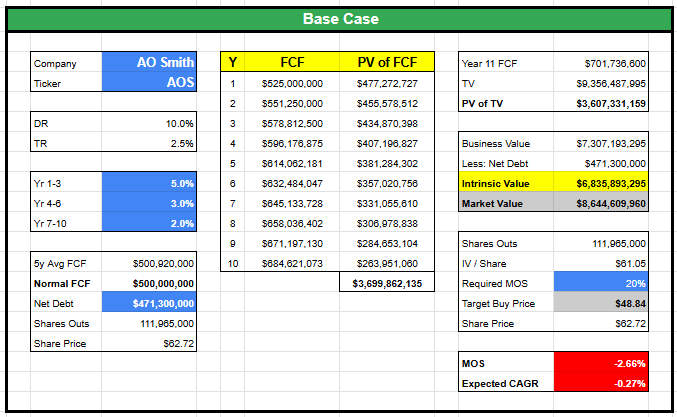
Base Case – Everything Goes Broadly as Expected
For my base case, I assumed A.O. Smith continues operating much as it has over the past decade.
I started with a normalised free cash flow of approximately $500 million, representing the average cash generation over the past five years rather than relying on a single exceptional year.
From there I projected free cash flow growth of:
5% annually for Years 1–3,
3% for Years 4–6,
2% for Years 7–10,
before applying a 2.5% terminal growth rate and a 10% discount rate.
These assumptions recognise two important realities.
First, A.O. Smith remains an exceptional business.
Second, it is also a mature one.
North America is well established, China is unlikely to return to its previous growth trajectory, and future growth is likely to come from premium products, water treatment and international expansion rather than rapid increases in unit volumes.
Under these assumptions, I arrived at an intrinsic value of approximately $6.8 billion or $61 per share. However, due to the expected slow growth of the business, I demand a 20% Margin of Safety so my buy price is around $50.
With the shares currently trading around $63, the market appears to be pricing A.O. Smith close to my Base Case fair value.
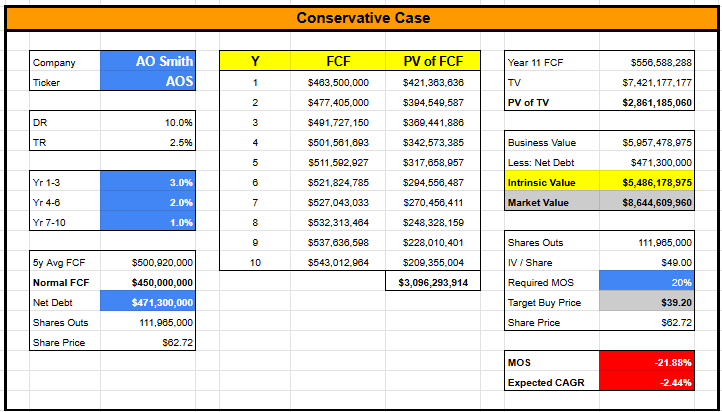
Conservative Case – Good Business, Slower Decade
No valuation should rely entirely on being right.
My conservative scenario assumes the business performs reasonably well but falls short of my expectations.
To reflect that possibility, I reduced the starting free cash flow to $450 million and lowered the growth assumptions to:
3%
2%
1%
The result was an intrinsic value of approximately $5.5 billion or $49 per share.
This provides a useful reminder that even exceptional businesses can disappoint if growth slows more than expected.
Interestingly, my conservative case prices the business around the same as my Base Case MOS Buy Price. Huh.
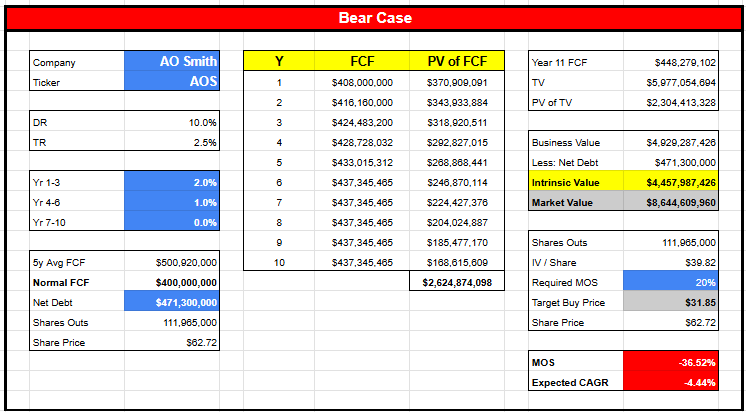
Bear Case – What If I’m Wrong?
The bear case is not intended to model disaster. This case is all about what my ultimate downside looks like.
Instead, it asks a more useful question:
What if A.O. Smith remains a good company but experiences a decade of disappointing growth?
For this scenario I assumed:
starting free cash flow of $400 million
2% growth for Years 1–3
1% growth for Years 4–6
0% growth for Years 7–10
Even under these assumptions, the business remains profitable and continues generating meaningful cash flow.
The intrinsic value falls to approximately $4.5 billion or $39 per share.
That reinforces one of the characteristics I admire most about A.O. Smith.
The downside appears to come from slower compounding rather than business failure.
My DCF Philosophy
The purpose of a DCF is not to produce a precise number. It is to produce a reasonable range.
With A.O. Smith, that range looks something like this:
Bear Case: ~$39/share
Conservative Case: ~$49/share
Base Case: ~$61/share
Given the company’s quality, I would still insist on a meaningful margin of safety before investing.
Personally, I’d begin paying close attention if the shares traded into the $35–50 range.
At those prices, the expected returns become much more attractive while still allowing room for mistakes in my assumptions.
Onto the Watchlist it goes!
Final Verdict
One of the biggest lessons I’ve taken from this analysis is that business quality and investment quality are not the same thing.
After completing all five rounds, I have little doubt that A.O. Smith is an exceptional business. The valuation simply suggests that the market already knows it. And that’s not a criticism of the company. It’s a reminder that even the best businesses can become mediocre investments if purchased without sufficient regard for price.
For now, A.O. Smith earns a place on my watchlist rather than in my portfolio. I’m more than happy to wait because in investing you need an edge and if I possess any edge whatsoever in this game it’s long-term owner’s mindset and patience.
If the business remains as strong as it is today and the market eventually offers it at a more attractive price, I’ll be ready.
The End
If you’ve made it this far then all I can say is thank you!
My first month on Substack has been incredible, I really feel like I’ve found a wonderful place and community - you guys are SO SUPPORTIVE. I’ve never experienced anything like it online before.
Please do bear in mind that this is literally the first real analysis I’ve ever done and I’m sure I’ve made a ton of silly rookie mistakes. Over time and with practice, I’ll continue getting better.
Either way, I finished my first business analysis and posted it on Substack so I’m proud of myself if I’m being honest.
Please feel free to give your feedback, thoughts, criticisms and troll insults in the comments or in private. I appreciate all of it.
For now, thank you!
Much more to come.
Liam.
I was analysing this company and I was worried about sales growth:
Sales growth last 5 years: 5.8% (annualized)
Sales growth last 3 years: 0.7% (annualized)
Sales growth 1 year: 0.23%
But maybe we are at the bottom of the cycle.
Only a month. Having read this article you are going to do very well. Many congratulations.