

If you’re new:
The Shallow Dive series is my attempt at making business analysis more accessible, easier to get through and more entertaining than your typical 3,564-page Deep Dive.
Rather than present you with every single thing I found in every single nook and cranny of the business - important or not - I’d much rather get straight to the point and give you the most important information to come out of my analysis ASAP.
I do not wish anyone to take my word as gospel. These are my opinions on the business and I am, despite what some people may tell you, a real-life human being. I’ve made a ton of mistakes and I’m absolutely positive I’ll make some more.
More than anything, my hope for every reader is very simple: that you enjoy the read!
Your Landlord’s Favourite App
Airbnb is cool.
You can take a property you own, a room you’re not using or that weird cabin in the woods near your house and charge visitors extortionate rates to stay there. All through a single platform!
When Brian Chesky, Joe Gebbia, and Nathan Blecharczyk founded the business in August 2008, it’s unlikely they envisioned a mobile app & website generating sales of over $12 billion a year, making all three of them billionaires in the process. And yet here we are.
As they enjoy their superyachts, the rest of us are annoyed that we didn’t think of it first. Yet again, a simple idea has proven to be incredibly lucrative.
Using my high-tech, always ultra-correct and extremely fun business analysis process that never ever fails, I’ve come up with my conclusion on Airbnb.
And what is that conclusion? Read the article bitch.
On to the analysis.
Round 1 - Predictability
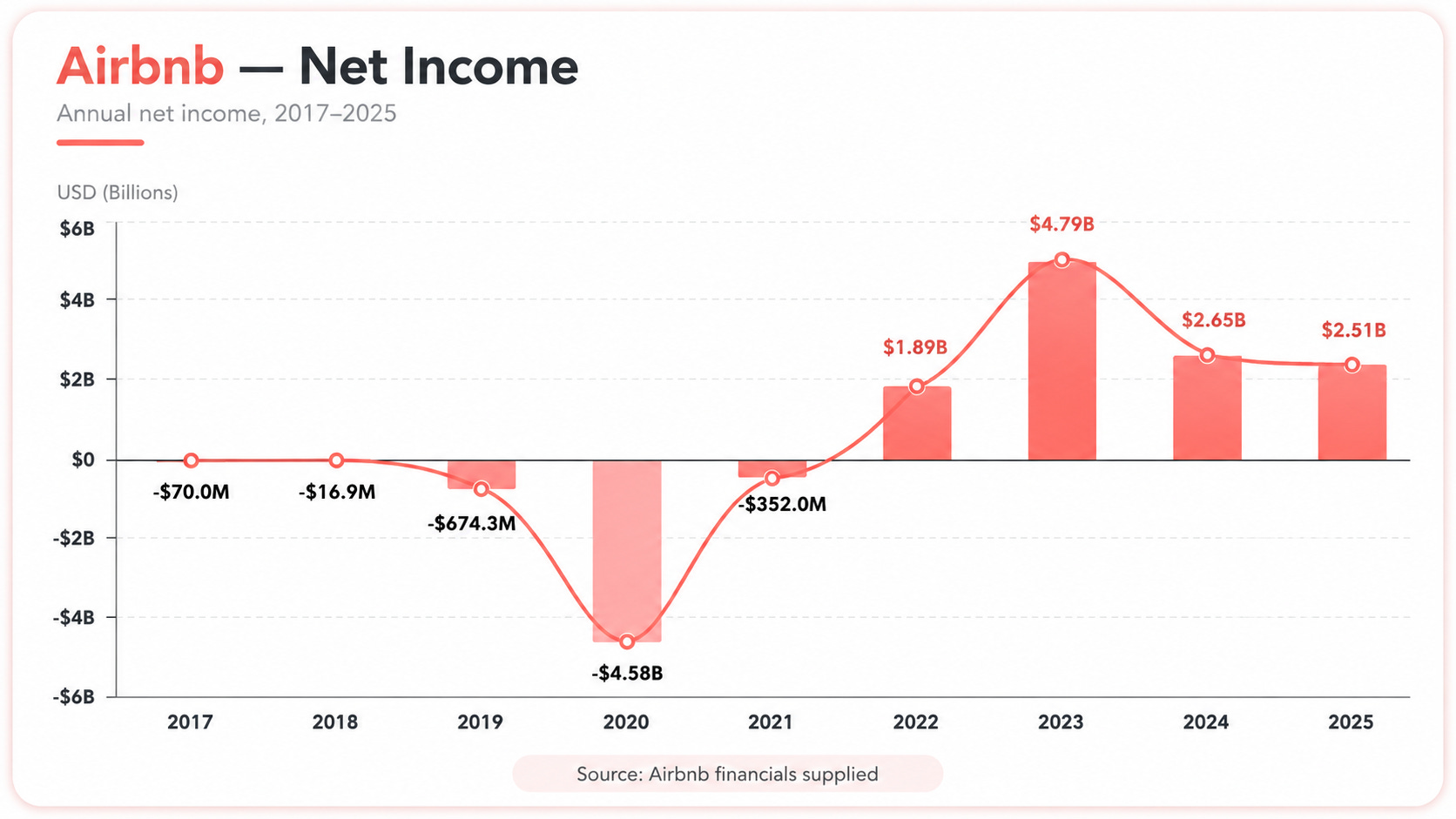
Admittedly, Airbnb’s predictability and, indeed, its profitability are fairly recent.
Net Income shows a business that has only just made the transition from burning cash to printing it, without having found a stable level yet. Free Cash Flow, however, looks much healthier.
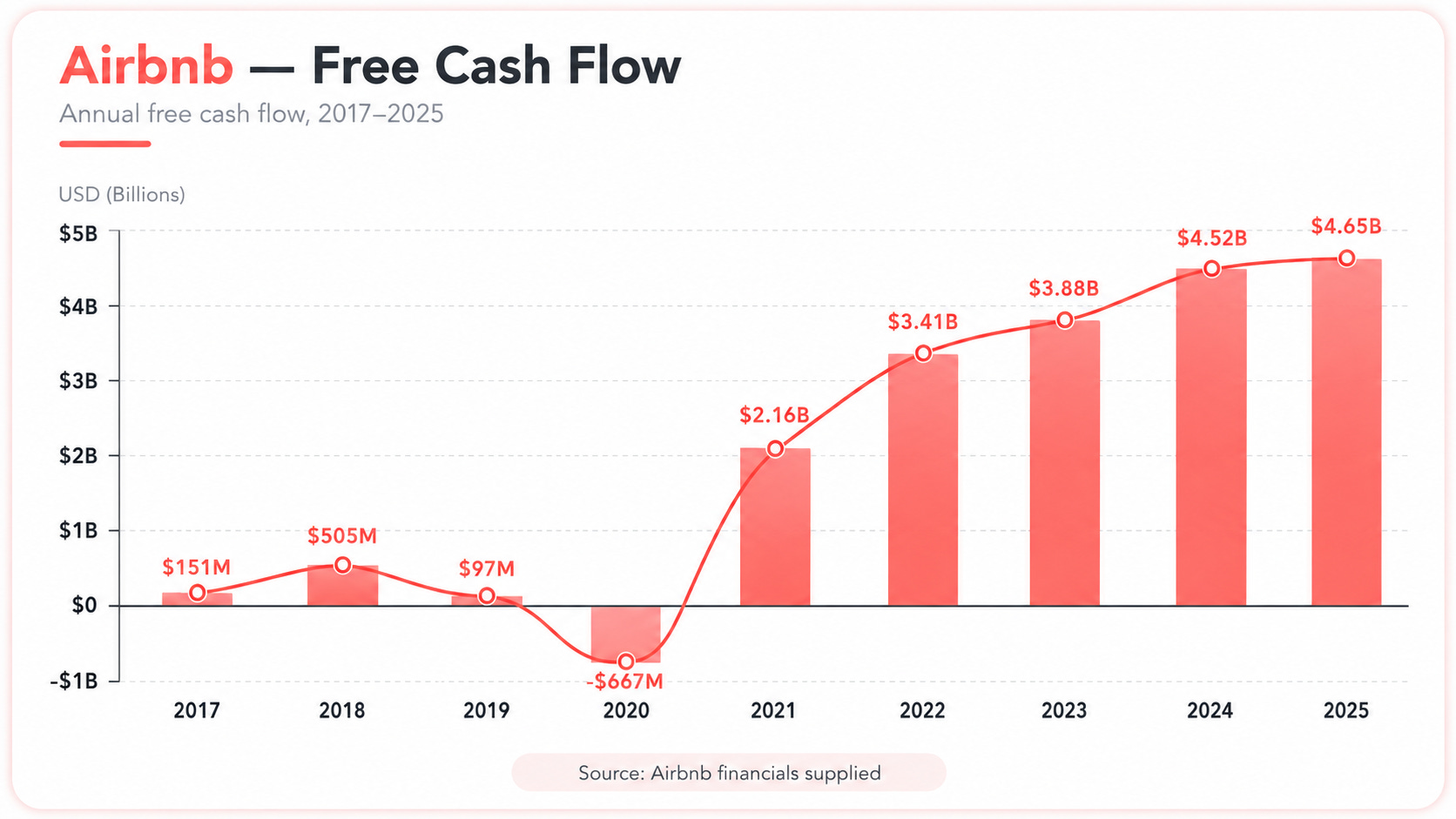
Ahhh yes, much better.
Airbnb has clearly become a cash-generative, somewhat predictable business. The main concern here is obviously the lack of historical data. We really only have about five years to base our assumptions on, making things just that bit more tricky.
Nonetheless, Airbnb passes Round 1, if only by the skin of its teeth.
Round 2 - Circle of Competence
Do I understand the business?
Yes, I’m literally a customer.
Round 3 - Financials
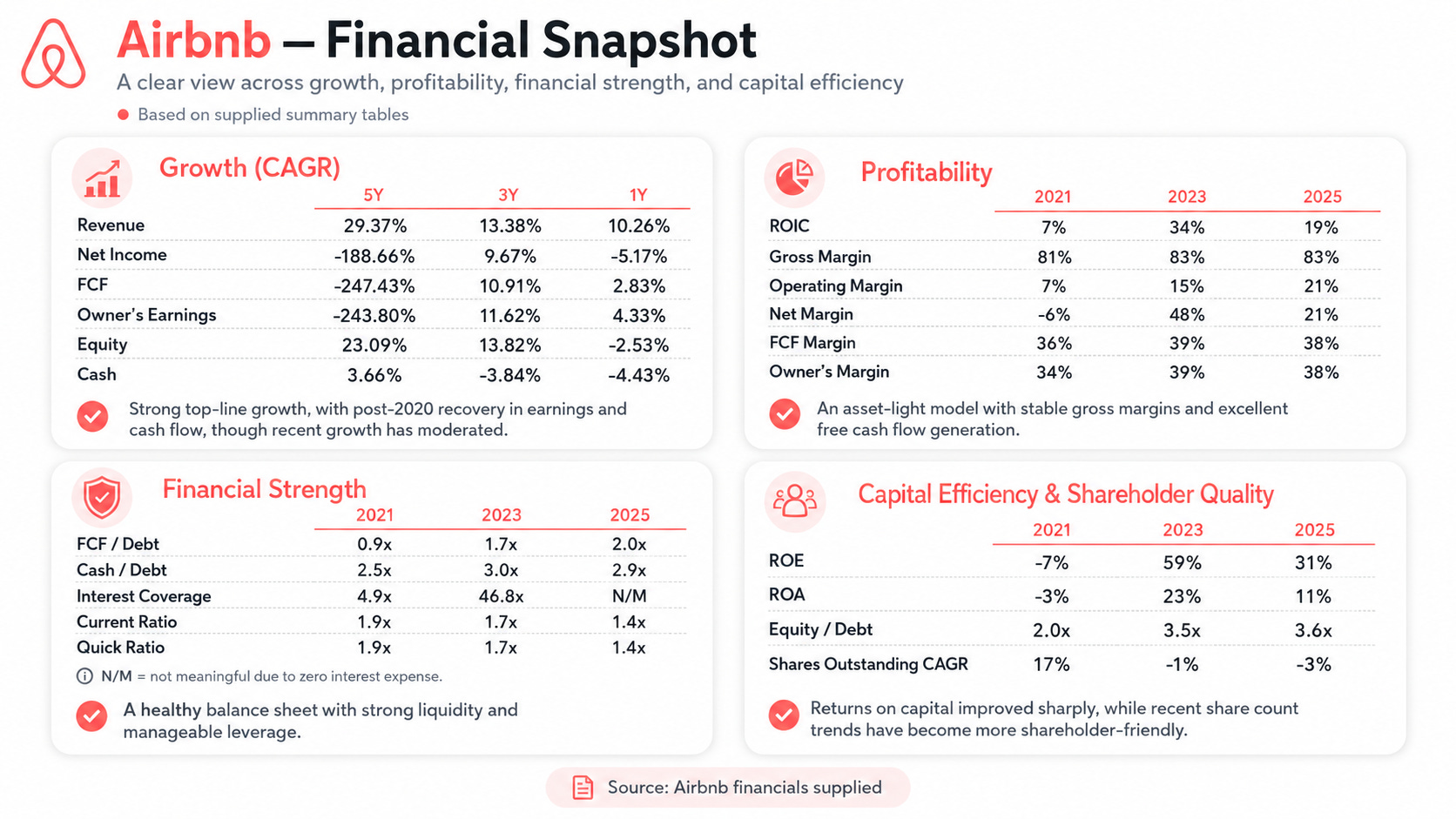
Looking at Airbnb post-profitability, everything looks really solid.
Maturity
From 2017 to 2025, sales grew from $2.6 billion to $12.2 billion. More recent growth remains respectable at around 10% in 2025, showing Airbnb is probably moving from a hyper-growth/recovery phase into a more mature growth phase.
Recovery post-COVID is also quite strong. For a business based entirely on their customers’ decision to travel, a global pandemic and worldwide lockdowns posed a serious threat. But management clearly navigated the storm well, achieving profitability very soon after.
Light as a Feather
Airbnb is extremely asset-light. FCF and Owner’s Earnings are almost identical, suggesting Airbnb needs very little Maintenance CapEx to keep the economic engine running.
It doesn’t need to own the hotels, aircraft, machinery or accommodation inventory that travel companies of the past required. It is a true example of the Platform Revolution.
Love, Family, Friends < ROIC
ROIC has dropped from a high of 34% in 2023 to 19% in 2025. On its own, 19% really isn’t bad at all. In fact, it’s quite tasty. But the drop is still something worth looking at as we progress through the rounds.
If I’m guessing, I would say it’s more likely a normalisation of returns rather than a deterioration of the business itself. But again, I’m guessing. And I’ve never been that great a guesser. The number itself isn’t really the problem; it’s the direction we care about.
Buybacks Baby
One other great thing to see is the steady decrease in shares from roughly 637m shares in 2023 to 613m in 2025. Not bad for a young, recently profitable platform.
Looks great. As we’ll discover later, there is an annoying asterisk attached.
What we don’t know, however, is whether management initiated these buybacks at good prices. There’s not much point in a buyback if the stock is 275% overvalued.
The Ugly Part
But what are my concerns? No business is perfect (except SpaceX, of course).
Overall, if I’m being fair, there’s really only one major one I could identify:
Future expansion. Airbnb is investing in international growth, Services, Experiences and other adjacencies, moving itself away from exclusively accommodation. This doesn’t sound all that bad and even makes for a natural evolution on the face of it.
The question though, is whether it can pursue those opportunities without sacrificing its current margins and capital-light model. This is yet to be proven.
Verdict
Airbnb scores Gold for Round 3: huge margins, enormous FCF generation, very low capital requirements, substantial net cash and still-strong returns on capital.
The concerns aren't that the economics are currently weak. The concern is that growth is moderating, ROIC has fallen, and Airbnb is entering a new, unproven investment phase.
Round 4 - Moat
Network Effects
Airbnb’s primary moat is the classic two-sided network effect:
More hosts create more choice for guests; more guests create more bookings, reviews and marketplace liquidity; that in turn attracts more hosts.
This self-reinforcing loop is the core reason Airbnb is so difficult to replicate.
It’s the same loop that gives the likes of Facebook, Instagram, Snapchat, LinkedIn and Uber such an advantage relative to their traditional industry competitors.
For example, Booking and Expedia largely compete around standardised hotel inventory, whereas Airbnb’s marketplace contains millions of individual properties that cannot simply be copied onto a new platform overnight.
A new competitor would have to attract hosts and guests simultaneously while overcoming Airbnb’s existing liquidity and reputation.
Extremely difficult over the long term and next to impossible over the short/medium term.
Linguistic Influence
The brand is another major advantage. Airbnb has effectively become synonymous with home-sharing and alternative accommodation.
More importantly, the brand has entered everyday language. People don’t just say they’re booking a holiday rental - they say they’re “getting an Airbnb”.
It benefits from a similar linguistic effect to Google. Just as people say “Google it,” travellers increasingly say “get an Airbnb”.

The brand now represents not just accommodation, but also trust, flexibility and a particular type of travel experience (and also really, really annoying hosts that bill you for not flushing the toilet).
Barriers to Entry
Substantial.
A serious competitor would need to recreate hosts, guests, reviews, trust, payments, fraud systems, regulatory expertise, brand recognition and marketplace liquidity. Simply throwing money at the problem would not be enough.
Entry costs are enormous too because Airbnb essentially perfected their niche. Booking and Expedia may be used as examples of competitors, but Airbnb doesn’t fit neatly into their industry descriptions. The advent of the internet, the power of network effects and the normalisation of asset-light, profit-heavy software businesses created the perfect storm for a business like Airbnb.
It Ain’t All Gravy
That being said, I’d be stupid not to include the things that concern me:
Hosts and guests can multi-home. Airbnb does not have complete customer lock-in, so switching costs are only moderate-to-strong rather than exceptional.
Pricing power has limits. Consumers can substitute toward hotels, other platforms or simply travel less if prices become unattractive.
Regulation is probably the biggest structural threat. Restrictions on short-term rentals in important cities could reduce host supply and weaken marketplace density in those areas.
The new initiatives are not proven yet. Services, Experiences and hotel expansion may strengthen the Airbnb ecosystem, but they could also absorb capital without producing attractive returns.
The moat is stable, not necessarily widening. There is no meaningful evidence of deterioration, but the newer initiatives have not yet done enough to justify saying Airbnb’s competitive advantage is clearly getting stronger.
All things considered, though, it’s hard to find a business with a moat as strong as Airbnb’s.
The concerns are real, but they aren’t thesis-breaking and there’s certainly no evidence of a deterioration of the moat.
The network itself basically acts as the ultimate shield against competitors and the industry at large.
Gold.
Round 5 - Management

This round is fairly straightforward.
Airbnb’s management is really good, probably above average, but not great.
The Good Stuff
Under Brian Chesky, management took a cash-burning machine into one of the most uncertain business environments in modern history (COVID) and turned the company into one that printed oodles of cash. That deserves a ton of credit.
It would also be fair to say that they have been very consistent strategically. They have focused on improving the core marketplace, expanding internationally and investing in trust, product and customer experience rather than chasing big glittery acquisitions or loading up on debt.
There’s no doubt these guys are good at what they do. But to achieve a Gold rating, you can’t just be good.
The Crappy Stuff
Stock-based compensation (SBC) is the biggest shareholder concern. SBC rose from about $899m in 2021 to $1.59b in 2025. Buybacks have reduced the net share count, but a meaningful portion of those buybacks is simply offsetting employee dilution.
I hate this.
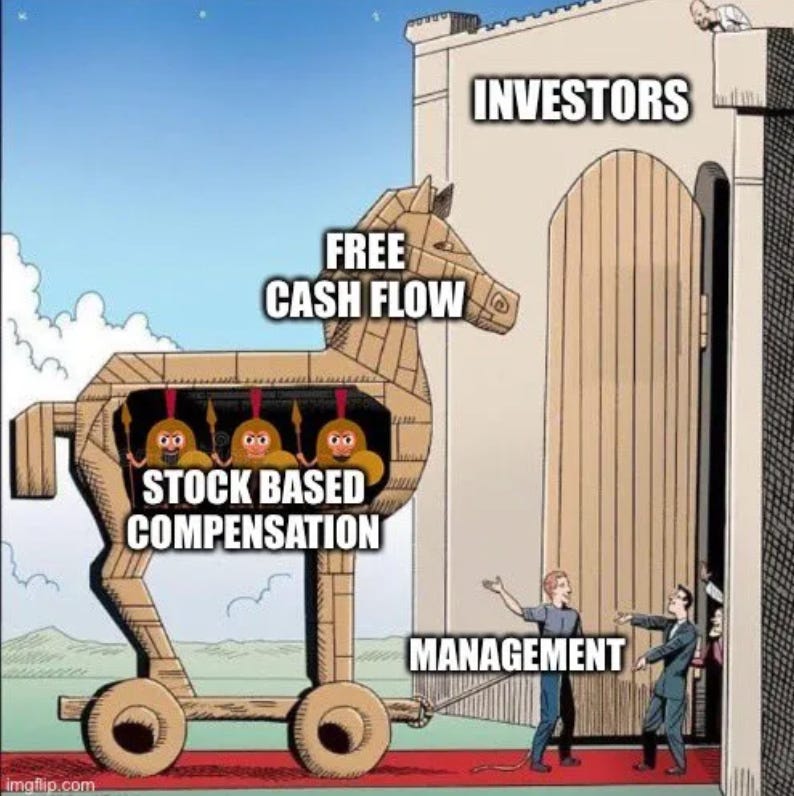
Governance is kind of weak, depending on your preference. Class B shares carry 20 votes per share versus 1 vote for Class A, so founders retain much more control than ordinary shareholders. That limits outside shareholders’ ability to challenge management if capital allocation or compensation deteriorates.
There is an argument that founder-led businesses actually have a huge advantage over non-founder-led companies as they can act in a more centralised way and make decisions based on the foundation of the founder’s original vision.
It’s a tough one. There probably isn’t a right answer.
In one sense, Chesky retaining a huge amount of control gives me confidence in the ongoing vision. But this also means you’re running the risk of one individual exercising too much control. Think Musk. Think Zuck.
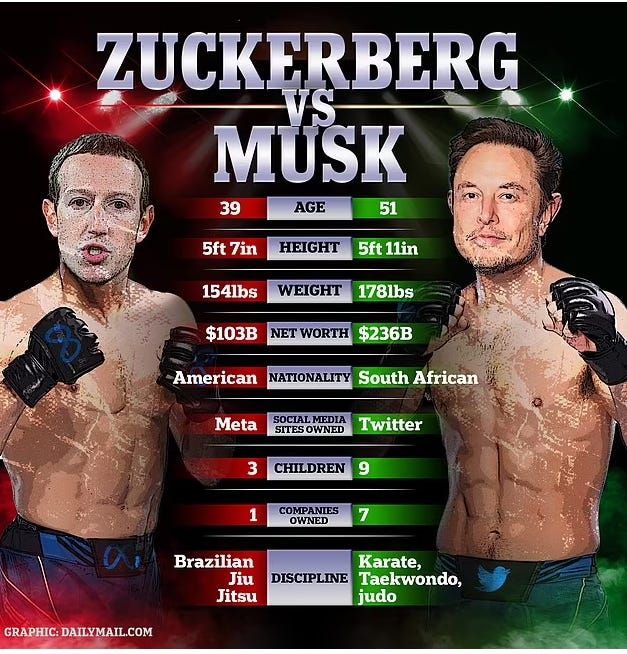
So far, this tightrope has been walked sensibly, but the risk remains nonetheless.
The “Who Knows?” Stuff
There’s also the side of Airbnb that is, so far, unproven.
The company is in a slight transitionary period. It seemingly maxed out the high-growth engine of bookings and seen it become a more stable and mature grower (not a criticism) and is now in search of the next growth opportunity.
The introduction of Services, Experiences and Hotels makes strategic sense, but they have not yet proven they can earn returns as good as the core business.
Is this a really nice add-on that will complement booking nicely or is it an example of Airbnb becoming more like its boring traditional competitors? Only time will tell.
Things aren’t deteriorating rapidly and the business is not managed by idiots. But there are definitely enough uncertainties surrounding Airbnb’s management team to stop me from giving them a full score.
Today, it’s Silver.
Round 6 - Owner’s Test
Okay, so you’ve done the work, you know the metrics and you can even recite, in order, the Quick Ratio for every one of the last 60 years.
But now it’s time to step away from the stats.
Now it’s time to look in the mirror.
You can lie to the whole world, but you cannot lie to yourself. Mostly. Actually, you can, I’ve done it a bunch of times.
Anyway, Round 6 boils down to a very simple question:
“If the stock market closed tomorrow for 15 years and I couldn’t see a daily share price, would I still genuinely want to own this business?”
For Airbnb, the answer is mostly yes.
There are concerns and the company is far from perfect. But this is a business that has really managed to carve out something special for itself. What I like most and what fills me with a ton of confidence as an Owner is how incredibly difficult it would be for anyone to replicate its achievements.
If I had to guess whether Airbnb will still be a leader in its field in 15 years’ time, I’d have trouble finding a logical reason today as to why it wouldn’t be. That basically says it all.
Now for the big reveal… the Valuation…
Before we value this thing, if you’ve enjoyed the article so far (which you obviously have), consider Subbing to the publication for more stuff like this!
Also, give your family a really confusing WhatsApp message by sharing the article to you Family Group Chat.
They’ll love it.
I promise.
Especially that mother of yours, she loves a good Discounted Cash Flow Model.
Round 7 - Valuation
Disclaimer: I take the simplicity of my valuations very, very seriously.
I run a simple and basic DCF on the business using conservative estimates.
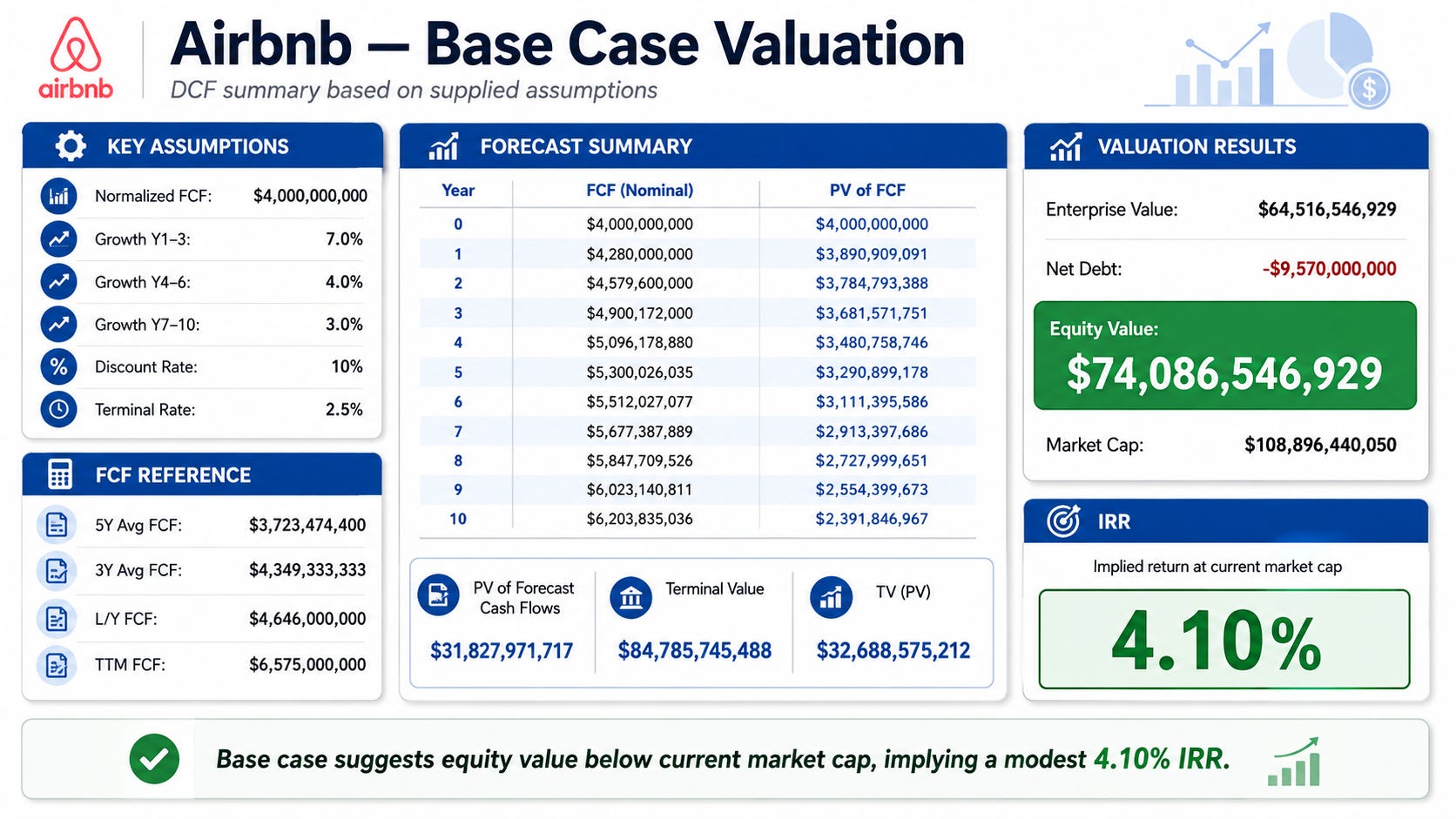
My inputs were as follows:
Normalised FCF of $4 billion.
Three declining growth rates of 7%, 4% and 3% over 10 years.
A Terminal Rate of 2.5%.
My standard Discount Rate of 10%.
A Net Debt figure of -$9.57 billion (net cash).
This gave me an Intrinsic Valuation of around $74 billion or $125-126 per share.
But, being the conservative and scared little mouse that I am, I don’t consider any valuation complete without some kind of Margin of Safety.
My typical default MOS of 20% seemed fair to me. This gave me a Buy Valuation of around $59 billion or $100-101 per share.
As I type this, Airbnb is trading at an 80+% premium to my price, so off to the watchlist it goes.
Conclusion
Airbnb is a fantastic business that scores highly in my framework and is more than worthy of ownership, in my opinion—just not at today’s price.
Airbnb August 2026 Final Conclusions:
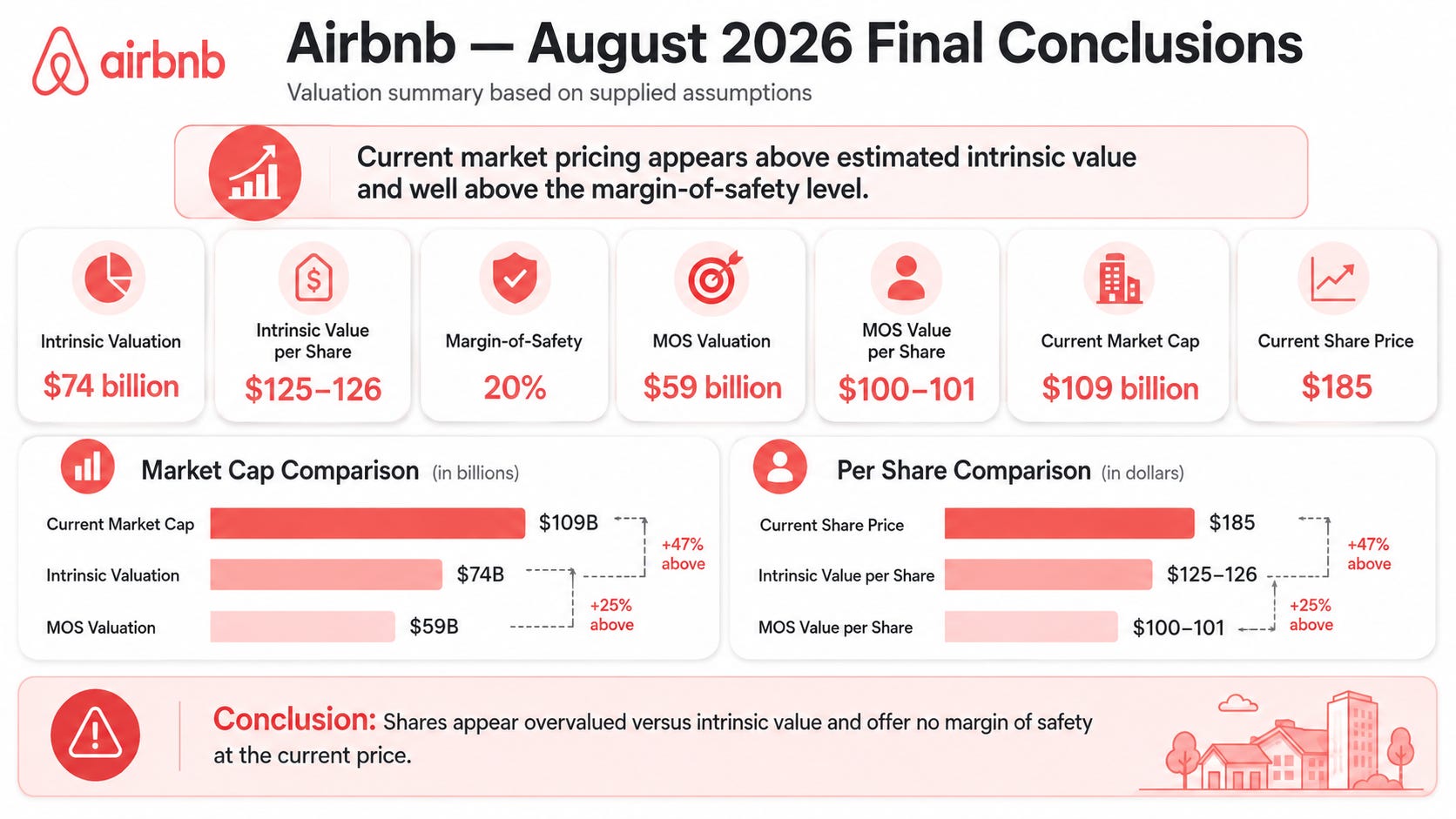
Intrinsic Valuation: $74 billion
Intrinsic Value per Share: $125-126
Margin-of-Safety: 20%
MOS Valuation: $59 billion
MOS Value per Share: $100-101
Current Market Cap: $109 billion
Current Share Price: $185
Premium / Discount: 84% Premium
Thank You For Reading
I see you’ve made it to the end of the article, you big reader you! You’re proving all those teachers wrong! You’re not a failure!
Or maybe you’ve just scrolled all the way to the bottom to see my Valuation. There’s really no way to tell.
Either way, it’s probably in your best interest to Subscribe and Share the article because we both know you enjoyed it immensely and agreed 100% with every single thing I said.
Let’s do it Liam!
Great work Liam. I’d say you’d doing yourself a disservice calling this a “shallow” dive.